The Insulin Resistance-Chronic Disease Connection

Insulin resistance can cause symptoms like weight gain, low energy, cravings, and thinking about food all the time. While these symptoms are unpleasant and affect your quality of life, insulin resistance is more important than needing a mid-afternoon cup of coffee or not being able to fit into your favorite pair of jeans.
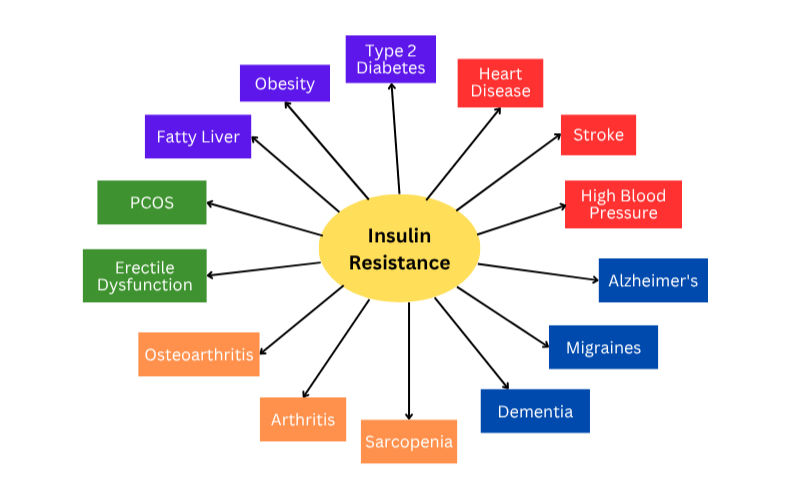
Insulin resistance is linked to dozens of chronic conditions, many of which don’t have an obvious association with elevated blood sugar. More connections are being discovered all the time.
Conditions Related to Insulin Resistance
There are dozens of conditions related to insulin resistance, including :
Obesity
Type 2 Diabetes
Nonalcoholic Fatty Liver Disease
Stroke
High Blood Pressure
Alzheimer's Disease
Migraines
Dementia
Sarcopenia
Arthritis
Osteoarthritis
Erectile Dysfunction
PMOS (Polyendocrine metabolic ovarian syndrome, formerly PCOS)
Beyond Blood Sugar: What insulin does in the body
To understand some of these connections, it's helpful to know that insulin is an anabolic hormone, which means its function in the body is to build complex compounds from simple ones.
Insulin resistance and obesity
Insulin also stimulates the production of and inhibits the breakdown of fat. Another way to look at that is when insulin levels are high, it's very difficult to break down fat and lose weight. Is it any wonder that low-fat diets, which are high-carb and insulin-stimulating, don't promote sustainable weight loss?
Insulin resistance and sarcopenia
Sarcopenia is a loss of skeletal muscle mass and strength. Since insulin is necessary to absorb amino acids and build proteins from them, it follows that if you are insulin-resistant and your cells ignore the insulin signal, they can become less effective at building muscle tissue.
Insulin resistance and dementia
Insulin plays many roles in the brain, including, but not limited to, providing energy to very energy-demanding brain cells. It also signals the consolidation of long-term memories and tells immune cells to clean up neural waste products. High insulin levels impair the breakdown of toxic proteins that are associated with Alzheimer's disease.
Insulin resistance, high blood pressure, and erectile dysfunction
You may be wondering what these two conditions have in common. Insulin triggers the release of nitric oxide, which relaxes and dilates blood vessels. Relaxed blood vessels lower blood pressure. Dilated blood vessels allow more oxygen to flow to organs that need it.
This is just a sample of the many different roles insulin plays in the body, and of how impaired insulin function contributes to chronic disease.
It might seem logical that more insulin is better, since it has so many important jobs, but that's not the case. Normal levels of insulin are enough to perform these vital jobs. The problem starts when too much insulin causes insulin resistance, and the body can't use it effectively.
Read more about insulin resistance in What is Insulin Resistance? And how do you know if you have it?
What is Insulin Sensitivity — and Why it Matters for Your Health.
The good news is that insulin sensitivity, which is when your body produces just enough insulin, but not too much, can be improved with diet and lifestyle strategies. Having optimal insulin sensitivity is one of the most important things you can do for your metabolic health.
Learn more about why metabolic health matters in What is Metabolic Health? And why should you care?
In my work as a holistic nutritionist, I most often work with two different kinds of clients:
Some want to address symptoms such as excess weight, low energy, or food cravings.
Others are what I call 'health optimizers.' They feel good, and they want to keep it that way by investing in their health to prevent future problems.
I had a delightful client several years ago who was in her mid-eighties. She worked with me because she had a lifelong habit of taking good care of herself, and when she learned about my program, she wanted in. In the years since, she has continued to travel with her family and produce beautiful paintings as a visual artist.
Whether you're struggling with specific symptoms or want your final chapters to look like my client's — active, creative, and fully engaged — the diet and lifestyle strategies that improve insulin sensitivity are the same. I customize them for every client in my program, Personalized Nutrition Coaching to Improve Metabolic Health.